The Heart of the Black Madonna

Sunday, November 6, 2022

The Stars on Her Mantle


We are about a month ahead of the Festival of Guadalupe, the Mestizo Madonna of Mexico. She is considered a Black Madonna because of her dark skin, and her image is a beautiful expression of the mixture of both Native and European features and symbolism. 


There are so many threads to Guadalupe of Mexico, that it would take hours to cover them all. In fact, I have written an entire book on the subject, The Virgin of Guadalupe, Mysterious Messenger of Destiny


In essence, Guadalupe of Mexico is a miracle, a story of evolution, of progression, of divine love and transformation. Her basic story is that she appeared to a Nahuatl Native on a series of days, December 9 - 12, 1531 to be exact, and the miracles surrounding her apparitions. On December 12th she imprinted her image on the cactus fabric Tilma (a poncho-type article of clothing of Nahuatl peasants of the day) in front of the Bishop of New Spain and his entourage. The image is on display in The Basilica of Guadalupe in Mexico City, Mexico, above the main altar. It has been constantly on display for nearly 500 years, as one of the most visited of all Marian Shrines in the world. This image has also been one of the most studied of all sacred items, being deciphered by chemists, physicists, photographers, you name it, and the only thing everyone can agree upon is that it defies explanation in earthly terms, other than the Virgin of Guadalupe of Mexico is a miracle.


The Virgin of Guadalupe is not art in the classic materialistic sense, meaning, an image comprised of a canvas covered with some sort of paint. Hundreds of years of materialistic scientific study, including modern computer  x-ray technology and chemical analysis, can not decipher what comprises this image that has inspired millions for nearly 500 years. But in a spiritual sense, Guadalupe is art, in that she conveys quite a message from the Gods. Guadalupe does this through every single fiber, every image, every aspect of the poetic narrative of her genesis, and most elegantly through her timing, the location of her apparitions, as well as her profound repeated statements of her apparitions to Juan Diego


Build me a Temple and Where are you Going?


There are many skeptics as to the nature of this image. One of the more interesting and accepted ones, is that it was painted by a Spanish artist schooled in Europe on the painting techniques of the day, about 60 years after the apparitions of Guadalupe. The "painting" was created to quell resistance to Spanish colonialism and insert the Catholic faith to the Natives in New Spain. 

Everyone is welcomed to draw their own conclusions as it is everyone's right to do so, but what I find most interesting in terms of refuting this notion, is the timing of the imprinting on the Tilma and the stars on the mantle of the Virgin.

With modern computer technology, we can plug in dates, locations and times and see how the stars were configured in the sky at any moment in history. If we look at the heavens above what is now called Mexico City at 10:40 am on December 12th, 1531, the exact timing of the miraculous imprinting of Guadalupe onto the Tilma, the heavens paint quite a picture. There is no way that an artist 60 years after the event could have known this. 

The heavens were pointing to the commencing of a new era in the evolution of humanity. The stars point to this. A tradition started nearly a century ago is to pray for 46 days leading up to the apparition of Guadalupe. There are 46 stars visible on the Tilma, hence the choice of 46 days, and each day leading up to the festival has a name (Star of Peace, Star of Hope and so on.) What is interesting is the symbolism of 46 in that it is the number of chromosomes in a human cell. Chromosomes are the essential structure, the template for creating a living being. In the number 46, for me, it points to the fact that Guadalupe is heralding the formation of a new structure for humanity, based on Cosmic Love.

As with all things, we have the freedom to choose this path towards universal and cosmic love.

What is your choice? Where are you going and what sort of temple will you be building to facilitate such a transition?


Monday, October 31, 2022

Our Lady of the Good Death


Our Lady of the Good Death, Clermont Ferrand, France


It is hard to know when exactly death started to terrify humans. In Medieval times, the common person's birthdate was not recorded, but their death date was, because it was seen as when the person entered "Real Life" in the hereafter.

In these times, it was important to have a good death, which meant being surrounded by those who one loved, and praying constantly for a good and holy transition. There is an order of Nuns in Brazil who are actually called The Order of Our Lady of Good Death. When someone in the community passes, these women sing and dance in order to accompany the soul into the next life.

There are many Black Madonnas associated with the underworld, with death, with transitions. For the next few days, from October 31 through to November 2, it is considered Allhallowtide Triduum, a time for honoring those who have passed. Dios de los Muertos is Mexican evolution of this tradition. Allhallowtide is a "time to remember the dead, including martyrs saints  and all faithful departed Christians." The present date of Hallowmas also known as All Saints' Day and thus also of its vigil (Hallowe'en the night before Hallowmas) was established for Rome perhaps by Pope Gregory III (731 - 741)  and was made of obligation throughout the Frankish Empire by Louis the Pious in 835. So the origins of Halloween are actually quite sacred, and it is odd to me it has been made such a scary secular production, while simultaneously being feared and avoided by many Christian sects. 

Halloween, All Saints Day and All Souls Day are sacred times within a community. Those who have passed before us, gave us so much. They are often still with us in many ways.

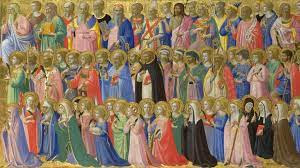
The Church Triumphant, Fresco by Andrea da Fierenza in Santa Maria Novella, Florence, Italy


I wish you all a sacred and reflective time this year as we begin our festival season leading up to Christmas and the New Year


Blessings!


Monday, October 24, 2022

The Modern Black Madonna

Oil Painting by Leanne Oliver


 The Black Madonna is an ancient artistic form. It seems that in cultures across the globe, some form of a dark mother has been part of the imagination since the dawn of time. During the age of exploration, manly from the renaissance on, there has been a retreat from the dark virgin. It is odd, since most of the world has people who are not pink skinned, regardless, the dominant focus has been on light skinned women in many aspects of religious art. These images are quite beautiful in and of themselves, but are also a bit alienating to those whose physical appearances differs greatly from the artistic presentation before them.

If one has ever been to a shrine honoring a Black Madonna, the mixture of intimacy with reverence is unique. These images invoke a profound response in many of the worlds peoples. Obviously Divinity does not have a specific skin color, nor gender actually. Divinity is supra sensible, and beyond much of our ways of understanding reality. Limiting Divinity can be, well limiting. But we must have a way to comprehend and understand Divinity, to feel as if we belong to these beings in some way. 

Humanity is reorienting itself in this great period of transformation. We have run the gamut of materialism and it is literally killing us and the planet upon which we depend. 

The Black Madonna is calling us back into the primordial velvet that once was our constant companion. We are more awake now, so the Black Madonna has deeper lessons for us.

May we hear and comprehend what it is the Madonna wants us to know.

We are one, yet individuals within the embrace of the cosmos. She has missed us, and await our fully conscious return.

Sunday, October 16, 2022

Black Madonna Resources

Our Lady of Jasna Gora, Czestochowa Poland


 It is hard to believe, but all of my efforts, relationship and writing with The Black Madonna are coming on to 20 years! Starting when I was a student enrolled in Sofia Institute through then Holy Names College in Oakland California, and now flourishing into a series of books, a podcast, active speaking schedule, I am somewhat of an expert in a now, in a newly joyously crowded field of amazing creators, authors and poets!


Starting in November, I hope to figure out how to change all of my Social Media "handles" to reflect the podcast. Everything takes me quite a while to figure out, as I am a staff of one along with being notoriously low tech. 

What I hope to convey through this blog post is a few of the resources I enjoy as a researcher and I hope you are enriched by them as well!


Our Lady of the Good Death, France


The two websites I find invaluable are

Black Madonna Index, Interfaith Mary Website

https://www.interfaithmary.net/black-madonna


University of Dayton Ohio Marian Library Website

https://udayton.edu/marianlibrary/index.php


Longing for Darkness Tara and The Black Madonna by China Galland


This was my first book on the subject, as part of the module on Feminine Spirituality through the Sophia Institute. It is a wonderful introduction to the subject, part travel journal, part historical review, part personal evolution of the author. While there is, obviously from the title, attention played to Tara a Hindu Goddess, there is much about the culture and history surrounding the Black Madonna.

The Cult of the Black Virgin by Ean Begg


There are two editions of this book. One is 2006 and the other which is often available through eBay, Goodwill, Thrift Books, and Abe Books and Amazon as a used book are editions from 1985 and 1996, I suggest hunting for these editions. I have both the 2006 and 1996 edition, as I see both as vital. The older version is an incredible resource as half the book is essentially an index of locations and folk lore about quite a few European Black Madonnas. I do not understand why the newer edition does not have this valuable resource, but there you have it.

The Black Madonna in Latin America and Europe: Tradition and Transformation by  Malgorzata Oleszkiewicz-Peralba


This is an excellent scholarly overview of Black Madonnas, as the title conveys, in Latin America and Europe. It is scholarly however, and may be a bit dry to read, but he information is quite valuable, well researched and a broad overview of the cultural implications of Black Madonnas in these regions. 


These are my go to sources, and I will add more, as more amazing titles, sites and artists are worthy of exploring! I suggest that these books and website are a good start for those wanting to delve into the subject matter a bit more.

Blessings on your Journey!

Monday, October 10, 2022

The New World

Our Lady of Regula, Spain


As we mark the 530th anniversary of the Columbian Voyage, the world is eerily similar to the turbulent days surrounding the time of that fateful event. I sometimes wonder if at the time, everyone knew how significant and world altering such a journey would become, or they were just interested in immediate results.

It has fascinated me for awhile now, the inherent discontent humanity has with its situation and surroundings. A casual observation of the entire history of humanity is one of constant relocation. I wonder if this tendency is a subliminal nod to our spiritual nature, that we are made up of the stuff of stars, and being earthbound temporary and  uncomfortable for us. We always seem to want something else, something new, over there has more of what we need, and the people living where we want to go are this great problem we must somehow solve often to the destruction of the other.


Unfortunately, every place on earth has certain drawbacks and limits, and humans constantly try to bring the familiar to the new. This tendency is odd, since one could have the familiar where they left, but it is the tendency to move about. This was certainly done with the Spanish expansions in the 16th century. Affectionately called "The Columbian Exchange" it was the greatest and swiftest transformations of ecologies and relocations of peoples at that point in global history. It id not occur to the Spaniard that there would be food in the new world, so they brought their plants and animals with them, destroying native ecologies along the way. It was also a time of great transformation and expansion of the Christian religion. Note the word "religion" and not necessarily The Christ Impulse.


Long strangled and stifled through politics and institutions, it is a miracle that any aspect of the universal love and intimacy Christ sought to bring into human awareness through his Incarnation ever seeped through the bloodied history of Christianity. One aspect of enhancing this awareness of the original intent was and is through the Madonna, particularly the Black Madonna. 


As Europeans dominated and oppressed numerous continents with the sanction of the Caucasian church deities, the Black Madonna became an image of inclusion and divinity to those who did not resemble or understand their conquerors ways. Our Lady of Regula is one of these images. She has her origins in Africa, traveled to Spain and then the rest of the world to become one of the most beloved images of divinity in the world. Is she sanitizing oppression, softening the blows of slavery and domination? Some may think so, I however do not. 


Our Lady of Regula is reported to have thwarted all attempts to whiten her skin. Her coloring allowed the Yoruba peoples transplanted to the Caribbean through the slave trade to find solace and strength in unimaginable circumstances, not to just obey but to endure with dignity the injustice of international corporate greed.


She still inspires to this day. May she inspire us to greater cooperation and recognition of divinity in all peoples. 


Monday, September 19, 2022

The Word Became Manifest

 There are two manifestations of Mestiza Madonnas in the Americas.


One is the miraculous and famous Virgin of Guadalupe of Mexico


The other is a less famous but also miraculous image of Las Lajas of Colombia.


One of the hallmarks of the Christian Impulse, is that Divinity came to Humanity. The prologue of the Gospel of St John states "The Word became flesh and dwelt among us..." John 1:14 This profound statement is worthy of contemplation for countless hours, but in essence describes how the being of Divinity, Christ, became a physical presence and lived among our human family. Christ incarnated at a time when humanity was so ensconced in the material, it was difficult to communicate with and sense the presence of the spiritual world.

The Christ Impulse and movement is not "just like all other religions." The main difference is that through this spiritual orientation, we understand that Divinity came to humanity, and inhabited a human body to understand and help transform the human/divine relationship. 

To have a human body on earth, one must be conceived in, gestate and be born of a woman.

A woman was essential to this entire divine process, and that woman was The Virgin Mary.

An interesting phenomena in the Americas is for the Virgin Mary to appear to natives and mixed race people, Mestizos, and ultimately imprint her image on physical matter.

The Virgin of Guadalupe of Mexico imprinted her image on cactus fiber.

The Madonna of Las Lajas in Columbia imprinted her image on stone.

The Americas are the most materialistic and dense lands on earth. The elementals in these vast territories are materialistic, the Natives knew and respected this reality, which is why mining and other forms of human activity that destroy the earth were never practiced here by the ancient peoples of the continent. The Natives knew such practices would unleash powers with which humans would have difficulty living. We can see the consequences of unleashing such power has done by Europeans to the people and land of the Americas.

The spiritual world often brings counter impulses to invite humans to  healing, moral and loving alternatives in contrast to destructive ideas and actions.

The Black Madonna does just that, and the Mestiza Madonnas in the Americas use the physical, material substance of cloth and stone to offer loving presence and alternatives to those who will listen.

In both Guadalupe and Las Lajas, spirit became manifest and is dwelling amongst the faithful.


Monday, September 12, 2022

Iberia and The Black Madonna

Guadalupe of Extremadura 


Art is a reflection of the evolution of human consciousness. It is also a reflection of human history. The Black Madonna for me is a reflection of the first thousand years of the Christian movement.


As humans were created to be the catalyst for the transformation of the Cosmos of Wisdom into the Cosmos of Love, we were given Freedom. To love involves freedom, as anyone who has experienced unrequited love will attest. But to have freedom, there has to be choice, and this was the reason for the introduction of evil into the world.


When Christ came, his purpose was to help us heal from all our freely chosen evil, for we would have been on a karmic cycle for infinity had he not. Ultimately the Cosmos of Love would never come to existence. The forces and legions of evil who had become accustomed to their earthly power were none too keen on this new development, and set to work immediately on thwarting new opportunities set into motion by the Christ Event. The main stumbling block to the widening Christ Impulse of love, freedom and equality was humanities affiliation with materialism. Materialism politically is expressed through power and greed. It is the main reason the Romans were so aghast against the early Christians, who simply were kind and loving to everyone. 


Constantine the Great decreed the official toleration of Christianity as a religion in the 4th Century, but he also knew of the power it represented. He co-opted the power by institutionalizing the movement. This concept became quite useful to secular power structures, specifically monarchies. As the centuries moved forward with the ever increasing connection between institutionalized religion entwining itself with monarchies, eventually there was quite a revolt against both. These movements resulted in the Protestant Reformation and various dynastic wars. 


On the Iberian Peninsula, there had been great conflicts over the invasion of Muslim conquerers. The resistance to such invasions took 700 years to complete, but it was finished by Ferdinand and Isabella in 1492. One of the only places the Muslims did not have control over was along the Northern Spanish Camino. This was also a place where the original Christ Impulse free from Roman influence flourished. There was an alternate liturgy, music, and of course The Black Madonnas dotted the landscape.


Could it be that these images along with the rituals and practice in the region represented a deep Christian mystery? Could it be these images were harkening to profound truths that challenged institutions?

The Iberian Peninsula was the embarking point for conquest, environmental degradation and religious persecution that spanned the globe. A counter to this stream was the healing message of The Black Madonna. As we face difficulties in our modern world, many that had their origins in the conquests initiated from this famed peninsula, let us look to the healing counter message of The Black Madonna for inspiration.